The Experiments of Emperor Frederick II
Frederick II was the most brilliant ruler of the thirteenth century, a patron of science who wrote a treatise on birds that still impresses ornithologists. According to one friar who knew his court, he also ran experiments on humans that ended in a barrel, at the bottom of the sea and on the dissecting table.
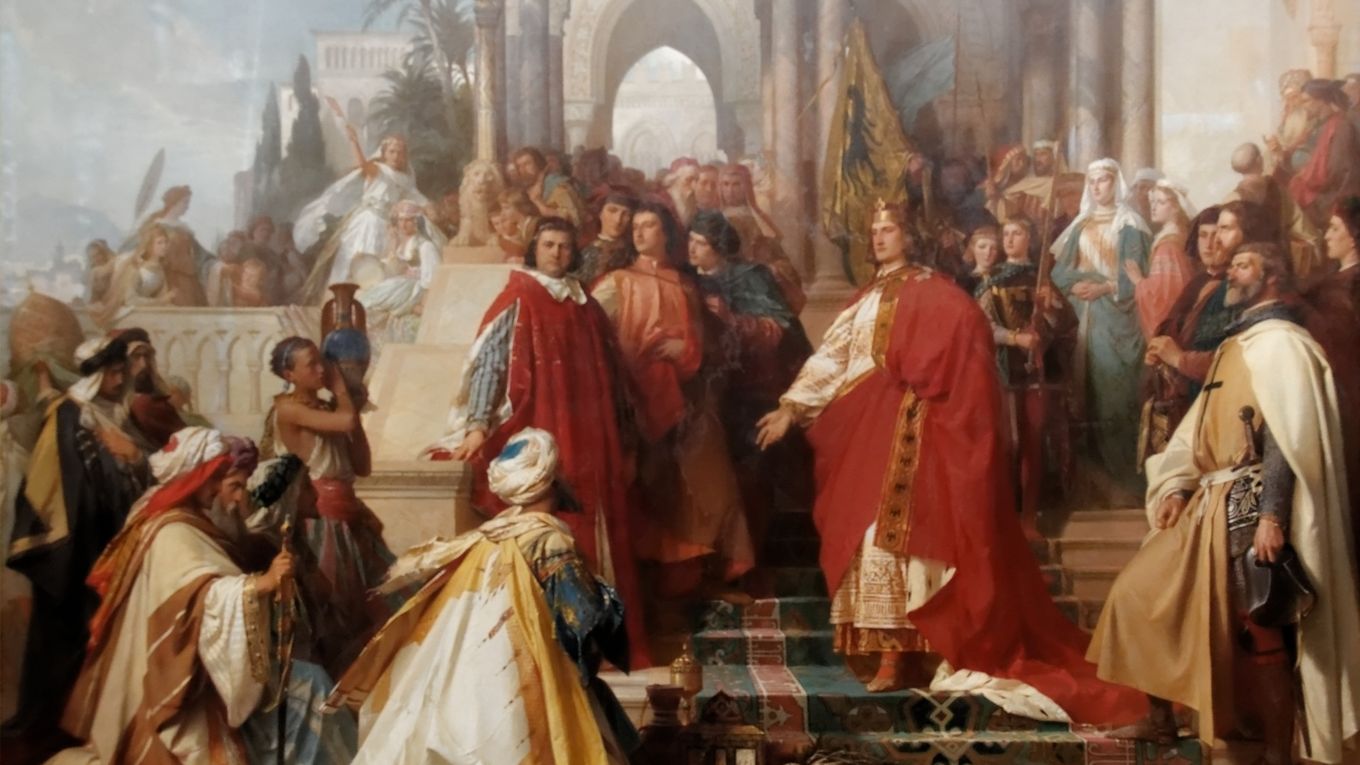

Two men sat down to the finest dinner the emperor’s kitchens could make. When they had eaten, one was sent to bed and the other was sent out hunting. That evening both were brought back before Emperor Frederick II, and in his presence they were disembowelled, so that his physicians could judge which man had digested his meal better. The verdict was the man who had slept. According to the Franciscan friar who wrote it down, this was just one of many experiments Frederick performed in the name of science.
The wonder of the world
Frederick II was born at Jesi, in central Italy, on the 26th December 1194. He inherited the crown of the German emperors from his father and the rich Norman kingdom of Sicily from his mother, and he grew up in Palermo. He was crowned Holy Roman Emperor in 1220. His court at Palermo and Foggia gathered some of the sharpest minds of the century: the mathematician Leonardo Fibonacci, the jurist Piero della Vigna and the Scottish scholar and astrologer Michael Scot, who translated Aristotle’s works on animals into Latin. In 1224 Frederick founded the University of Naples. Contemporaries called him stupor mundi, “the astonishment of the world.”
The papacy would have had less complimentary names for him; Frederick spent most of his reign at war with the popes over the control of Italy. Gregory IX excommunicated him in 1227 and again in 1239, and papal propaganda cast him as a forerunner of the Antichrist. In 1245 the Council of Lyon declared him deposed. Half a century after his death, Dante put him in the sixth circle of Hell among the heretics, in a burning tomb with the Epicureans, those who “make the soul die with the body.”
The friar who hated him, but once loved him
Almost everything we know about Frederick’s human experiments comes from one man. Salimbene di Adam was born in Parma on the 9th October 1221, and at 16 he ran away to join the Franciscans. His father wanted him back, and Frederick himself wrote to Brother Elias, the head of the order, asking him to send the boy home. Salimbene never forgot it; “I have seen him,” he wrote, “and once I loved him.”
Parma turned against Frederick, and in 1247 the emperor laid siege to it, intending to starve them into submission he built a whole fortified town outside the walls and named it Vittoria the Italian word for victory. This backfired in February 1248 when the Parmesans broke out and burned it to the ground. Salimbene, a Parmesan himself and by now a friar of an order sworn against the excommunicated emperor, spent the war writing The Twelve Calamities of Frederick II, a pamphlet that matched the emperor’s sins against the plagues of ancient Egypt. Some 35 years later, in his chronicle, he set down a list of what he called Frederick’s “curiosities.” He said he was too weary to tell them all.
His portrait of the man was not one of simple hatred. Frederick, he wrote, was “crafty, wily, avaricious, lustful, malicious, wrathful,” yet “a gallant man at times,” funny, charming and gifted, and “if he had been rightly Catholic … he would have had few emperors his equals in the world.” Then came his description of the experiments.
The babies who were never spoken to
Frederick wanted to know what language human beings would speak if nobody taught them one. According to Salimbene, the emperor decided to put the question to the test. He took newborn babies and handed them to foster-mothers with a strict order: they were to suckle the children, bathe them and wash them, “but in no wise to prattle or speak with them.” Frederick intended to learn whether the children grew up to speak “the Hebrew language, or Greek, or Latin, or Arabic, or perchance the tongue of their parents.”
He never found out; the babies did not grow up to speak anything. They were fed and cleaned, but still they died, “the children could not live without clappings of the hands, and gestures, and gladness of countenance, and blandishments,” Salimbene wrote.
The story was not new. Herodotus, writing in the fifth century BC, told how the Egyptian Pharaoh Psammetichus had two children raised in silence by a shepherd and claimed their first word was Phrygian. Did Frederick replicate the earlier experiment or had Salimbene borrowed an older tale and attributed it to a contemporary villain?
The man in the cask
According to Salimbene, the emperor “enclosed a living man in a cask that he might die there, wishing thereby to show that the soul perished utterly.” The man was sealed inside and left there until he died.
Popular retellings add a detail that Salimbene does not: a small hole bored in the cask, so that Frederick could watch for the soul escaping as the man died.
Dinner then disembowelment
Frederick “fed two men most excellently at dinner, one of whom he sent forthwith to sleep, and the other to hunt; and that same evening he caused them to be disembowelled in his presence, wishing to know which had digested the better.” His physicians examined the half-digested food in the two opened stomachs and ruled in favour of the man who had slept.
Nicholas the Fish
Salimbene’s list also includes a death at sea. At Messina lived a man called Nicholas the Fish, cursed by his own mother, so the story went, to spend his life in the water. Frederick threw a golden cup into the sea and ordered him to fetch it. Nicholas dived, reached the bottom and brought it back. So Frederick threw it in again, to the very bottom of Charybdis, and made him go down a second time. Nicholas, Salimbene says, knew that this time he would die. He never came back up.
This one is almost certainly folklore. Stories of a Sicilian merman called Nicholas were circulating long before Salimbene; the English writer Walter Map had told one in the twelfth century about a King William of Sicily. The tale of Colapesce, as he is called there, is still told in Sicily, sometimes with Frederick in the role of the emperor who sends him to his death.
The sinking palace
One day, while standing in his palace, Frederick asked Michael Scot how far they were from the sky. Scot worked it out and gave an answer. Frederick then took him away on a trip for several months, and while they were gone he had his architects and carpenters secretly lower the whole palace hall. When they returned, he casually asked the question again. Scot did his calculations and said that either the sky had risen or the earth had sunk. Frederick, Salimbene says, then knew that his astrologer was telling the truth.
Rumour, propaganda and a real scientist
Salimbene was not a careful witness to these events. He saw Frederick in person, but he was a boy and then a young friar on the other side of a war. He wrote of the experiments decades after the emperor’s death, and he does not claim to have witnessed a single one of them. The historian David Abulafia, author of a leading modern biography of Frederick, calls him a “shameless gossip.”
What makes the stories difficult to dismiss entirely is that Frederick really did run experiments which he recorded himself. In the 1240s he wrote De arte venandi cum avibus, “On the art of hunting with birds,” a vast treatise on falconry and bird life that promised to describe “things as they are.” It is full of his own observations, and it repeatedly corrects Aristotle. To find out whether vultures located carrion by smell or by sight, he had their eyelids stitched shut and put meat in front of them. They could not find it, and he concluded that “a vulture is not attracted to his carrion food by his sense of smell … but relies on his eyesight.”
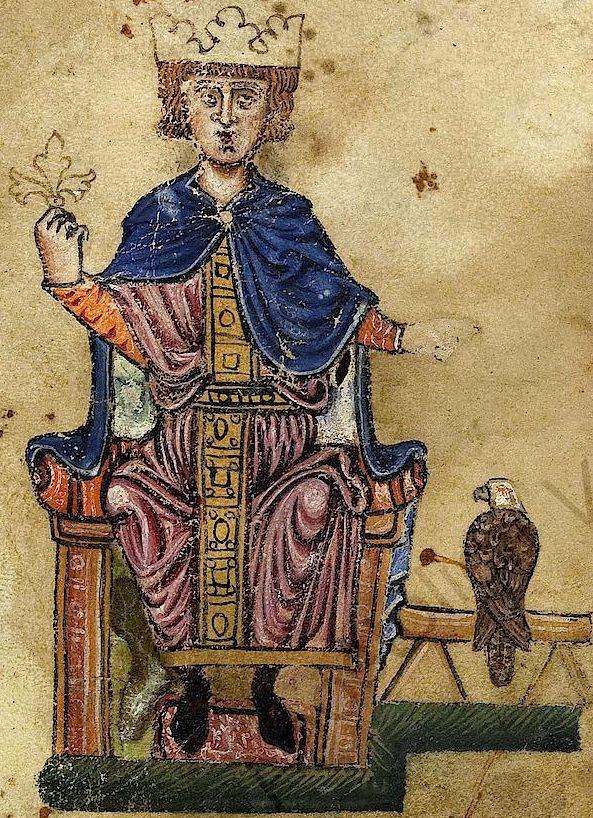

Frederick was a man who had animals’ eyes stitched shut in order to test a hypothesis. It is therefore not so difficult to imagine that his relentless curiosity might also have led him to experiment on people. Salimbene had no need to invent this side of Frederick’s character; his fascination with experimentation, sometimes pursued with striking disregard for suffering, was real. Yet Salimbene was also deeply hostile to the emperor and had every reason to portray him in the worst possible light. His more disturbing stories therefore occupy an unknowable territory between fact and invention: they may be malicious fabrications, exaggerations of real events, or essentially true accounts embellished little in the telling.
Questions and answers
Did Frederick II really carry out experiments on people?
Nobody can prove that he did or didn’t. The only source for the experiments on the babies, the man in the cask and the two disembowelled men is the chronicle of Salimbene, a hostile Franciscan friar from Parma who wrote decades later and did not witness any of them. Historians treat the stories with great caution, though Frederick’s experiments on birds show he had the curiosity and the disregard for suffering that the stories are built on.
What did Salimbene have against Frederick?
Salimbene was a Franciscan, and his order sided with the papacy against an emperor who was twice excommunicated and eventually declared deposed. He was also from Parma, the city Frederick besieged in 1247 and 1248. Yet he admired the emperor’s talents, and he never forgot that Frederick had once written to the head of the Franciscans on his father’s behalf.
What experiments do we know Frederick actually did?
His own treatise on falconry, written in the 1240s, describes several. He had vultures’ eyes stitched shut to show they found carrion by sight rather than smell, he tested whether eggs could hatch in the heat of the sun, and he had driftwood brought from the north to check the legend that barnacle geese grew on trees.
Key dates
- 26th December 1194
- Frederick is born at Jesi in central Italy, heir to both the German emperors and the Norman kings of Sicily
- 9th October 1221
- Salimbene, the future chronicler of Frederick's experiments, is born in Parma
- 1224
- Frederick founds the University of Naples
- 29th September 1227
- Pope Gregory IX excommunicates Frederick for the first time
- 4th February 1238
- Salimbene joins the Franciscans; Frederick writes to the head of the order asking for the boy to be sent home to his father
- 1239
- Frederick is excommunicated a second time
- 1240s
- Frederick writes De arte venandi cum avibus, including his experiments on vultures and his test of the barnacle goose legend
- 1245
- The Council of Lyon declares Frederick deposed
- February 1248
- The people of Parma destroy Victoria, Frederick's siege camp outside their city
- 13th December 1250
- Frederick dies at Castel Fiorentino in Apulia
- c. 1282
- Salimbene begins his chronicle, which records Frederick's human experiments
Further reading
Frederick II: A Medieval Emperor
David Abulafia · A biography of Emperor Frederick II covering his reign, his Sicilian court and his reputation as 'Stupor Mundi'.
View on Bookshop.org: Frederick II: A Medieval Emperor
Frederick the Second: Wonder of the World, 1194–1250
Ernst Kantorowicz · A classic biography of Frederick II, first published in 1927, examining his court, intellectual circle and legend.
View on Bookshop.org: Frederick the Second: Wonder of the World, 1194–1250This article contains affiliate links. If you buy through them, Yorewire may earn a small commission at no extra cost to you. Affiliate disclosure.
Sources
- 1Salimbene on Frederick II, from G. G. Coulton, St. Francis to Dante (London: David Nutt, 1906), pp. 242–43, Internet Medieval Sourcebook, Fordham University (The primary source: Coulton's English translation and paraphrase of Salimbene's list of Frederick's 'curiosities', including the infants, the cask, the disembowelled men, Nicholas the Fish and the lowered palace hall.)
- 2G. G. Coulton, From St. Francis to Dante: Translations from the Chronicle of the Franciscan Salimbene, 2nd edition (1907), Internet Archive (Full scan of Coulton's book, for Salimbene's life and his wider portrait of Frederick.)
- 3Benjamin Breen, 'A Medieval Emperor's Natural Language Experiment', Res Obscura, May 2018 (Written by a historian of science at UC Santa Cruz; quotes David Abulafia's verdict on Salimbene as a 'shameless gossip' (Frederick II: A Medieval Emperor, p. 252).)
- 4'Salimbene di Adam', Wikipedia (For Salimbene's dates, the single Vatican manuscript of the chronicle and the Twelve Calamities pamphlet.)
- 5'The First Textbook of Ornithology?', American Ornithological Society (On De arte venandi cum avibus, the vulture experiment and the egg-hatching test, quoting the 1943 Wood and Fyfe translation.)
- 6Stacey R. Murray, 'The Art and Science of Falconry', Science and Its Times, via Encyclopedia.com (Covers Frederick's test of the barnacle goose legend and his other observations on birds.)
- 7'De arte venandi cum avibus', Wikipedia (For the date of the treatise, its preface and Manfred's illustrated Vatican copy.)
- 8'Emperor Frankenstein: The Truth Behind Frederick II of Sicily's Sadistic Science Experiments', All About History, 19 August 2017 (Magazine article drawing on Abulafia, Masson and Bressler; used for the papal and Dantean view of Frederick.)
- 9'Frederick II, Holy Roman Emperor', Wikipedia (For the dates of Frederick's life, excommunications and deposition, and his court.)
- 10'Colapesce', Wikipedia (For the older versions of the Nicholas the Fish legend before Salimbene.)