The Viking Earl Killed by a Dead Man's Tooth
Sigurd the Mighty conquered much of northern Scotland and had just won a bloody battle. Riding home with his defeated rival's head hanging from his saddle, he was scratched by one of its teeth, soon after he was dead.
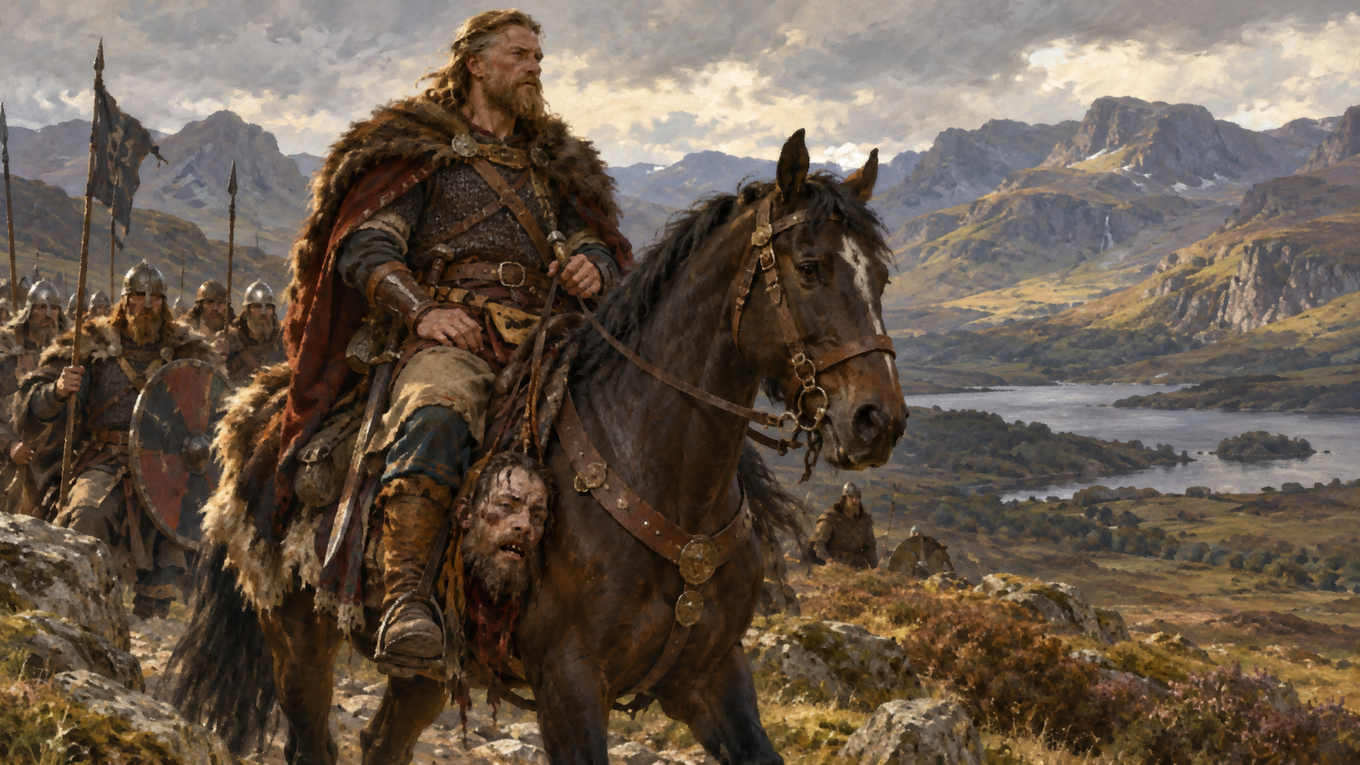
Somewhere in the north of Scotland, towards the end of the ninth century, a Norse war band rode home from a slaughter. From every saddle hung a severed head. The victorious earl, Sigurd the Mighty, had tied on the head of the man he had just killed, a Scottish earl named Máel Brigte “the Bucktoothed” because of a tooth that jutted from his mouth. As Sigurd rode, he went to kick his horse on, and his calf struck the tooth. It was only a scratch, but the leg soon swelled and grew painful, and not long after, the conqueror of Caithness and Sutherland lay dead.
The earl from Møre
Sigurd Eysteinsson came from one of the great families of western Norway. He was the son of Eystein Glumra and the brother of Rognvald, earl of Møre, one of the most powerful allies of King Harald Fairhair, the man remembered as the first king of all Norway.
According to the Icelandic sagas, when Harald won the kingdom, many of his defeated enemies fled west across the sea. They wintered in Orkney and Shetland and spent their summers raiding the Norwegian coast. Harald sailed west to hunt them down, clearing the islands and harrying as far as the Hebrides, Scotland and the Isle of Man. In the fighting, Rognvald’s son Ivar was killed, and to make up for his loss, the king gave Rognvald Orkney and Shetland. Rognvald returned to Norway and handed the islands to his brother Sigurd, who had served as Harald’s forecastleman, the warrior stationed in the prow of the king’s ship. Before sailing home, Harald made Sigurd an earl.
Sigurd was not content with the islands. He allied himself with Thorstein the Red, son of the Norse king of Dublin, Olaf the White, and together they crossed to the Scottish mainland. The Orkneyinga saga says they conquered “all Caithness and much more of Scotland,” pushing south into Ross and Moray, and that Sigurd built a fortress on the southern border of Moray. His conquests earned him the nickname inn ríki, “the Mighty.”
Máel Brigte the Bucktoothed
Almost nothing is known about the man who killed him. His name, Máel Brigte, is Gaelic and means “devotee of St Brigid.” The saga calls him “an earl of the Scots,” and historians think he was probably a mormaer, a regional ruler, of Moray, whose power centre may have been at or near modern Inverness. What the Norsemen remembered was his face: they called him Melbrigða tǫnn, usually translated as Máel Brigte “the Bucktoothed.”
Máel Brigte had watched the Norsemen carve up his neighbours’ lands, and at some point the two earls agreed to meet and parlay.
Treachery
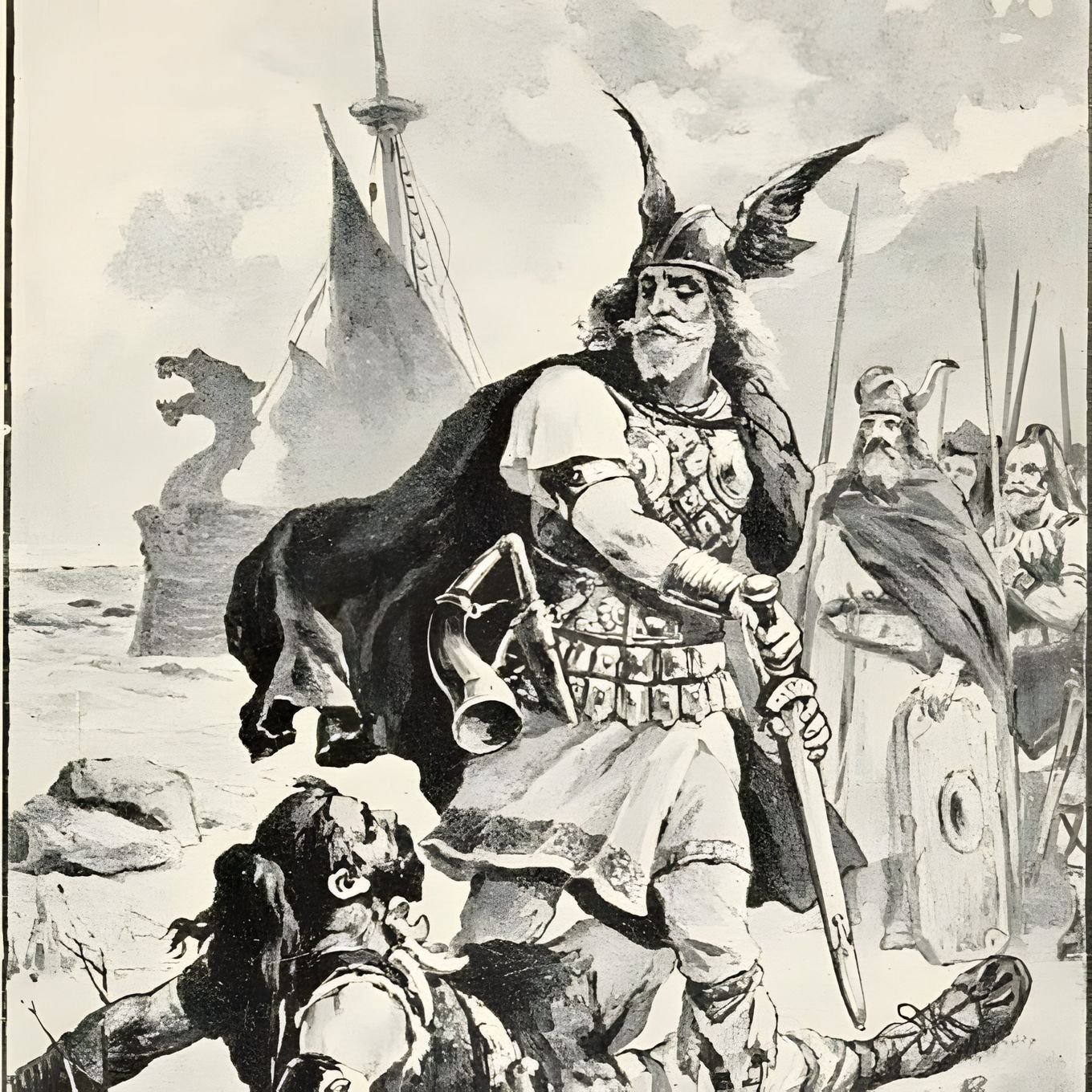
The meeting was set for an agreed place, with forty men on each side. Sigurd, according to the saga, “was suspicious of treachery on the part of the Scots,” so he broke the terms first. He mounted eighty men on forty horses, two to each saddle.
Máel Brigte saw through it as soon as the Norsemen came into view. “Now we have been treacherously dealt with by Earl Sigurd,” he told his men, “for I see two men’s legs on one side of each horse, and the men, I believe, are thus twice as many as the beasts. But let us be brave, and kill each his man before we die.”
Sigurd had a plan prepared: half his men dismounted to attack the Scots from behind while the rest charged straight into them on horseback. “There was hard fighting immediately,” the saga says, “and it was not long till Máel Brigte fell, and all his men with him.”

The tooth
The victors cut off the heads of the dead and fastened them to their saddle straps “in bravado,” and rode home in triumph. Naturally, Sigurd carried the head of their leader.
The saga describes what happened next in a single sentence. Sigurd, “intending to kick at his horse with his foot, struck the calf of his leg against a tooth protruding from Earl Melbrigd’s head, which scratched him slightly; but it soon became swollen and painful, and he died of it.” Snorri Sturluson, retelling the story around 1230 in Heimskringla, has the head hanging from Sigurd’s stirrup-leather: “the calf of his leg was scratched by the teeth, which were sticking out from the head, and the wound caused inflammation in his leg, of which the earl died.”
It sounds like a moral fable, the cheat struck down by his victim, but from a medical standpoint the tale is quite likely. Human teeth carry potentially deadly bacteria, including staphylococci, streptococci, Eikenella corrodens and anaerobic bacteria. Infected human bites often contain several species at once. Even with modern treatment, human bite infections are serious.
Sigurd had no antibiotics, no way of cleaning the wound properly and no idea what was happening inside his leg. The saga says only that it swelled, grew painful and killed him. Modern writers assume the infection spread into his blood, which would result in death by sepsis.
Sigurd’s Mound
Sigurd was buried, the saga says, “in a mound at Ekkialsbakki,” the bank of the Ekkjal. The river is almost certainly the Oykel, which flows into the Dornoch Firth in the far north of Scotland. As Laing’s 1844 translation of Heimskringla notes, the burial mound “may be still remaining possibly.”
The place-names suggest people remembered it for centuries. In the charter setting up the cathedral chapter of Caithness, drawn up between 1223 and 1245, the church’s treasurer was granted the tithes of a place near Dornoch called Siwardhoch, “Sigurd’s mound.” The name was later written Sytheraw, appears as Siddera on Blaeu’s atlas of 1640, and survives today, garbled, as Cyderhall, a farm on the north shore of the Dornoch Firth. The antiquarian Dr Joass identified the grave with a twin-topped hillock called Cnoc Skardie, and the tradition is still known locally.
The grave itself has never been found. When the Ordnance Survey visited in 1971, there was no trace of a burial there. Excavations at Cyderhall did uncover a burial, but it was radiocarbon dated to between about AD 998 and 1155, more than a century too late to be Sigurd’s.
The fallout
Sigurd’s death threw the new earldom into disarray. His son Guthorm ruled for a single winter and died childless. Rognvald sent out his own son, Hallad, but Hallad could not stop the Vikings who went “prowling about the islands,” killing men and seizing plunder. He gave up the earldom and sailed home to Norway, and his return, the saga says, “was regarded as a very ignominious one.” The islands finally went to Rognvald’s youngest son, Torf-Einarr, the son of a slave woman. His descendants would rule Orkney for centuries.
How much of it is true?
The Orkneyinga saga was written in Iceland around 1200, some three centuries after Sigurd died, and Heimskringla around 1230. The historian Alex Woolf has compared the saga writer’s task to writing a history of the Second World War “on the basis of Hollywood movies.”
We cannot know for certain that Sigurd was killed by a dead man’s tooth, but the story was passed down by word of mouth for three centuries, it was remembered in remarkable detail, the place of his grave was still being named in the thirteenth century, and the cause of death is very plausible.
Questions and answers
Could a small scratch from a tooth kill?
Yes. Human teeth carry potentially deadly bacteria, and infected human bites can spread to the joints, the bone and the bloodstream. Before antibiotics, a wound that became badly infected could very easily prove fatal.
Who was Máel Brigte?
He was a local leader in northern Scotland, probably a mormaer of Moray, a Gaelic title for a regional lord. Apart from the saga, nothing is known about him. The Norse nickname tǫnn, “tooth,” refers to a prominent buck tooth, which is why he is known in English as Máel Brigte the Bucktoothed.
Where is Sigurd buried?
The sagas say he was buried in a mound on the bank of the Ekkjal, almost certainly the River Oykel. A thirteenth-century charter names a place near Dornoch Siwardhoch, “Sigurd’s mound,” now Cyderhall. Tradition points to a hillock there called Cnoc Skardie, but no grave has been found, and the one burial excavated at Cyderhall dates from more than a century after his death.
When did it happen?
The saga gives no date. Historians usually place Sigurd’s rule at around 875 to 892, which would put the battle and his death at the end of the ninth century.
Key dates
- c. 872 or later
- According to the sagas, Harald Fairhair wins the Battle of Hafrsfjord and becomes king of all Norway
- c. 875
- Sigurd Eysteinsson becomes earl of Orkney and Shetland after his brother Rognvald gives him the islands
- c. 875–892
- With Thorstein the Red, Sigurd conquers Caithness, Sutherland and parts of Ross and Moray
- c. 892
- Sigurd kills Máel Brigte the Bucktoothed, is scratched by the dead man's tooth and dies of the infected wound
- c. 1200
- The Orkneyinga saga, the main source for the story, is written down in Iceland
- c. 1230
- Snorri Sturluson retells the story in Heimskringla
- 1223–1245
- The charter founding the cathedral chapter of Caithness names a place near Dornoch 'Siwardhoch', Sigurd's mound
Further reading
Orkneyinga Saga: The History of the Earls of Orkney
trans. Hermann Pálsson and Paul Edwards · The medieval Icelandic saga of the Earls of Orkney, including the death of Sigurd the Mighty.
View on Bookshop.org: Orkneyinga Saga: The History of the Earls of Orkney
The Children of Ash and Elm: A History of the Vikings
Neil Price · A history of the Viking Age and the world in which earls such as Sigurd the Mighty operated.
View on Bookshop.org: The Children of Ash and Elm: A History of the VikingsThis article contains affiliate links. If you buy through them, Yorewire may earn a small commission at no extra cost to you. Affiliate disclosure.
Sources
- 1The Orkneyinga Saga, trans. Jón A. Hjaltalín and Gilbert Goudie, ed. Joseph Anderson (Edinburgh, 1873) (Public-domain English translation of the saga, with Anderson's introduction and notes on Sigurd's burial mound and the charters naming it.)
- 2Snorri Sturluson, Heimskringla, trans. Samuel Laing (London, 1844), Saga of Harald Fairhair, ch. 22 (Snorri's shorter version of Sigurd's death, written around 1230.)
- 3James Gray, Sutherland and Caithness in Saga-Time (Edinburgh, 1922) (Local historian's account of the Norse conquest of the far north and the identification of Sigurd's Howe with Cyderhall.)
- 4'Burial Place of Sigurd the Powerful, Cnoc Skardie' (MHG12994), Highland Historic Environment Record (Official heritage record for the traditional site of Sigurd's grave near Dornoch.)
- 5'Pagan Viking Burials', Highland Archaeological Research Framework, Scottish Archaeological Research Framework (ScARF) (Summarises the archaeology of Norse graves in the Highlands, including the burial excavated at Cyderhall.)
- 6Jeffrey Barrett, 'Human Bites', Medscape Reference (updated December 2024) (Clinical overview of infections caused by human teeth, the bacteria involved and their complications.)
- 7'Orkneyinga saga' and 'Sigurd Eysteinsson', Wikipedia (Used for the modern debate over the saga's reliability, including Alex Woolf's comparison with Hollywood films (Woolf, From Pictland to Alba, 2007).)