Project Habakkuk: The Aircraft Carrier Made of Ice
Geoffrey Pyke's plan for an ice aircraft carrier 600 metres long won the attention of Churchill and was tested on a lake in the Canadian Rockies. It never went to sea, but its model still lies on the lakebed.
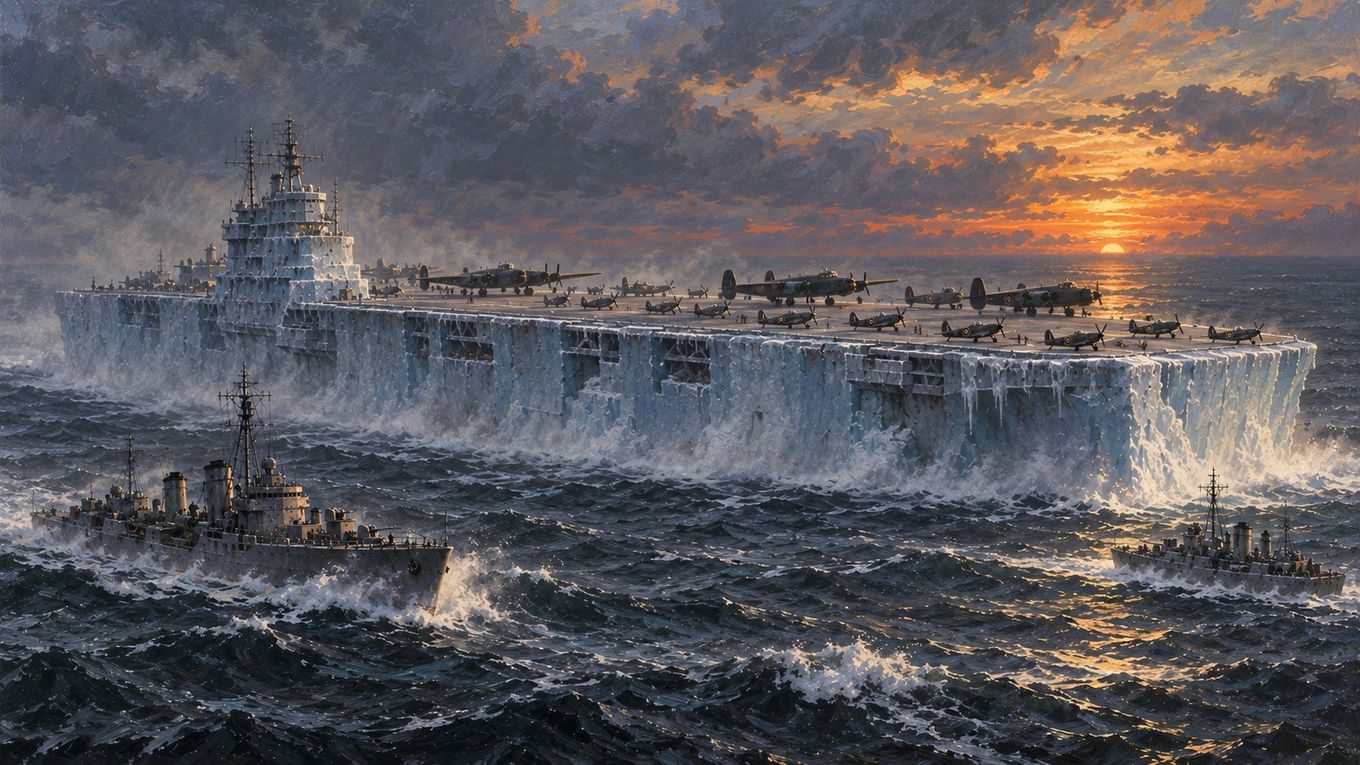
Imagine an aircraft carrier that can only be described as a 600 metre long fortified, floating airfield, with hull walls 12 metres thick, made of frozen water and wood pulp. That was the plan Winston Churchill and the Allies took seriously in 1943. If built it would have displaced around 2.2 million tons. It was called Project Habakkuk, and its backers hoped it would provide aircraft cover in the middle of the Atlantic, closing a gap several hundred miles wide where Allied convoys crossed with no air support. Land-based patrol planes flying out of Iceland, Newfoundland and Northern Ireland could not fly that far out, and German U-boat crews were taking advantage of it, they gathered in that gap and attacked convoys with impunity.
No full-size version was ever built, but a scale model was built on a lake in the Canadian Rockies. It survived a summer, then was left to melt and sink once the experiments had ended.
A floating airfield in the Atlantic
In the autumn of 1942 the U-boat war was at one of its most critical phases, and the Allies were short of air power in distant theatres, as the scientist Max Perutz wrote in his 1948 account of the project. Convoys crossing the middle of the Atlantic passed through a gap that land-based aircraft could not reach.
The idea for closing it came from Geoffrey Pyke, who was not a naval architect by trade but a metals speculator who had made a fortune trading tin. Born in 1893, he had been a war correspondent in Berlin in the First World War, escaped from an internment camp there, and ran an experimental school in the 1920s. In 1942 Lord Louis Mountbatten, the chief of Combined Operations, made him a scientific adviser. In September 1942 Pyke put a 232-page document to Mountbatten describing huge aircraft carriers made of ice. The code name came from the biblical book of Habakkuk.
A ship of ice looked cheap on the face of it, and supporters claimed that damage could be patched by freezing more water into the holes. The trouble was that normal ice is brittle and it melts too quickly.
Ice with an added ingredient
The answer was pykrete, named after Pyke: water frozen with added wood pulp, which popular accounts put at about 14 to 15 per cent. Perutz’s group tested it. It was much stronger than normal ice, melted slower and could be worked like wood. Against bullets and explosives, Perutz reported, it was pound for pound as good as concrete. A block took rifle fire with only slight cratering, where normal ice fractured and split apart.
There was a catch. Ice creeps, under load it slowly flows, like a glacier. Perutz found that a pykrete ship would only keep its shape if it stayed below about minus 15 °C, which meant thick insulation and constant refrigeration.
The plan on paper
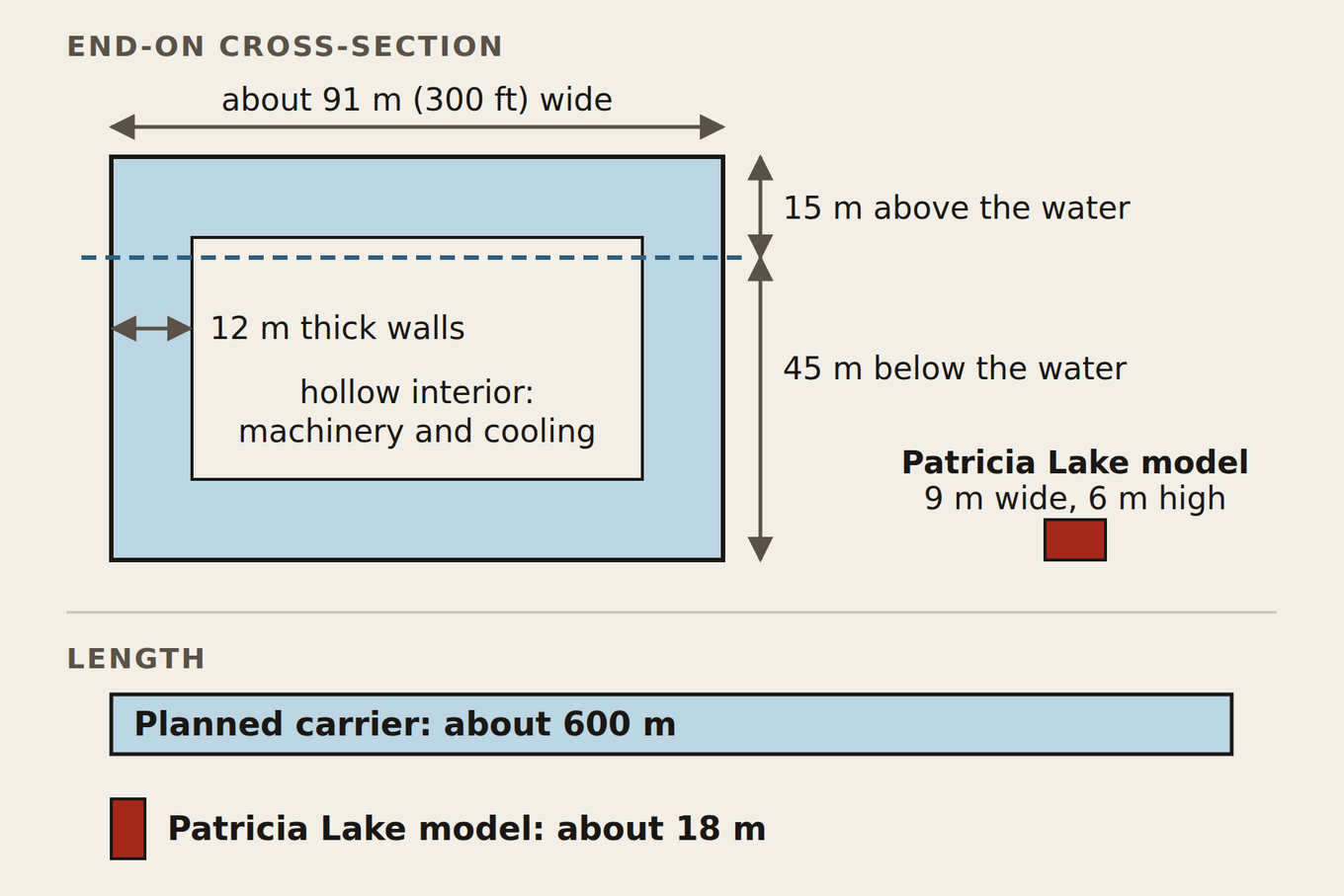
The flight deck was planned to be about 600 metres long and stand 15 metres above the water, with a draught of 45 metres and a displacement of 2.2 million tons. It would have had a beam of about 90 metres and walls at least 12 metres thick, the hull was hollow to take the machinery and cooling plant.
The plan called for turbo-electric propulsion, with the Warfare History Network putting the top speed at seven knots or more and the range at about 7,000 miles. Counts of the aircraft it would have been able to carry range anywhere from 150 to 300. The ship would have needed some 300,000 tons of wood pulp, a serious amount of pulp to source during a war.
Next to real carriers
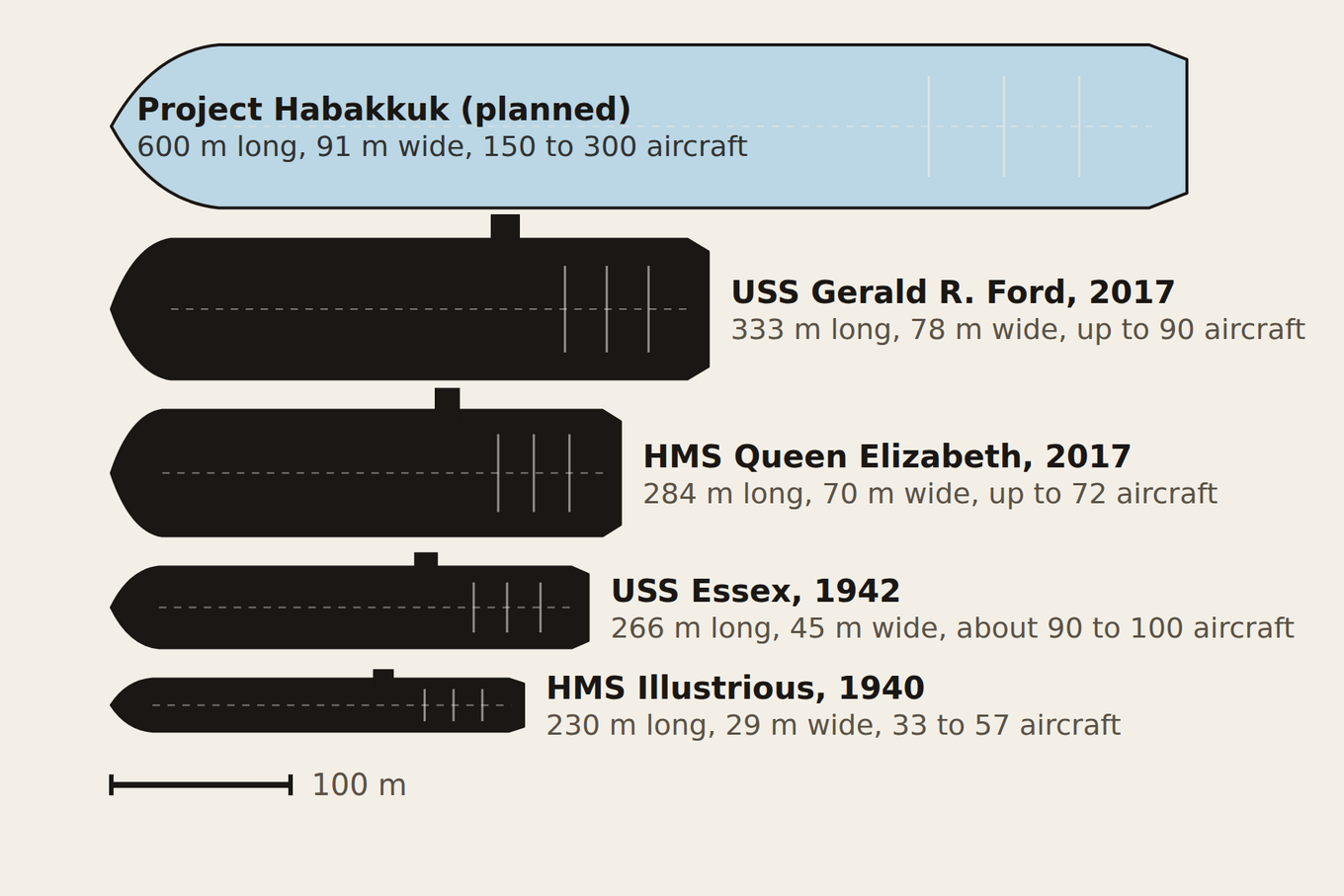
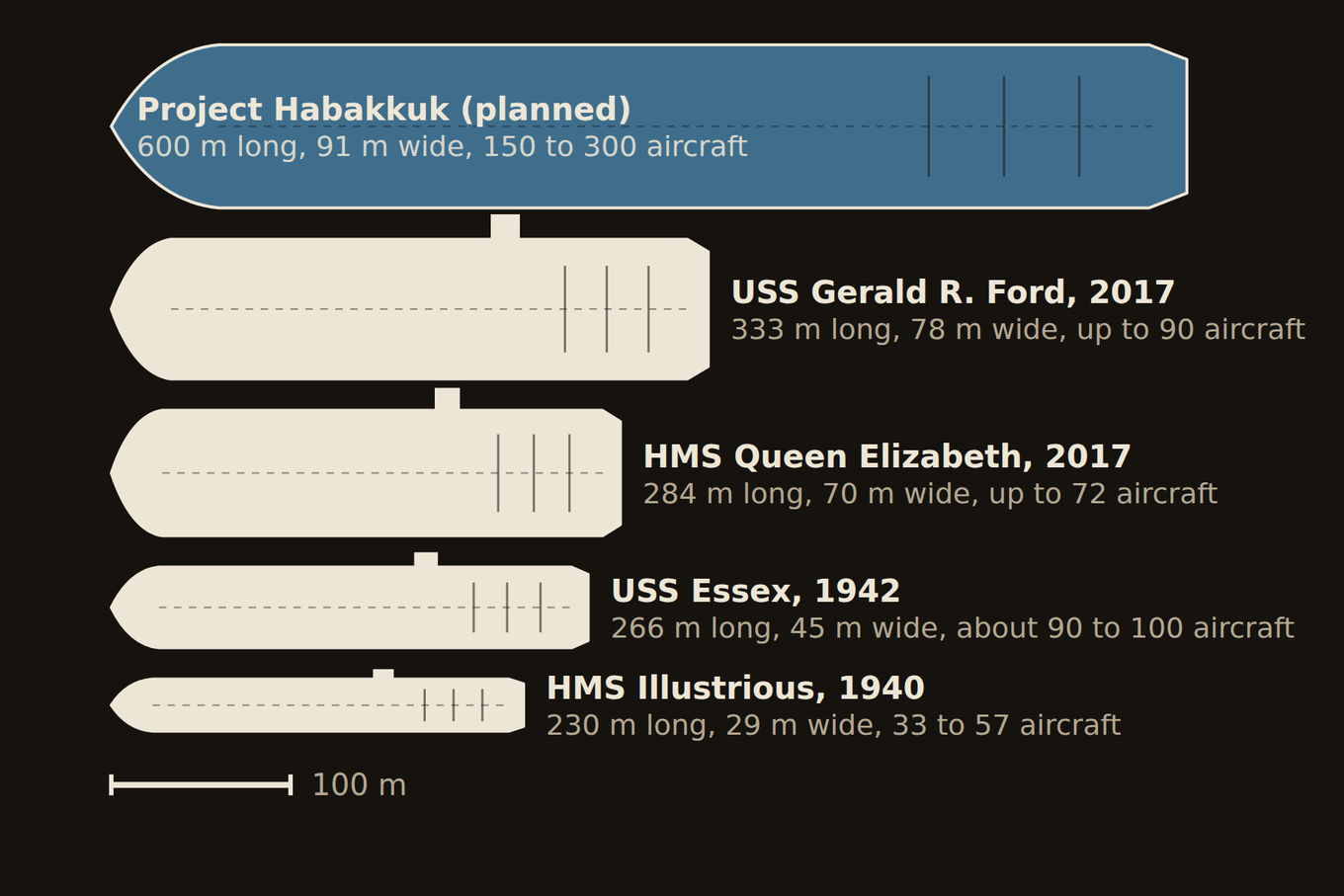
It’s difficult to imagine the scale of such a vessel, so to put it in perspective: HMS Illustrious, commissioned in 1940, was about 230 metres long and 29 metres across at the hull, it could carry 57 aircraft with a permanent deck park. USS Essex, commissioned in 1942, was about 266 metres long and 45 metres across at its widest, and could hold roughly 90 to 100 aircraft.
Modern aircraft carriers are bigger, but not by as much as you might expect. USS Gerald R. Ford is about 333 metres long with a flight deck 78 metres wide, and it carries up to 90 aircraft. HMS Queen Elizabeth is 284 metres long with a flight deck 70 metres wide, and it can carry up to 72 aircraft.
Habakkuk was on another scale. On paper it was about 1.8 times as long as the Ford and more than two and a half times as long as Illustrious, and its width of about 90 metres was greater than either modern flight deck. Its planned displacement of 2.2 million tons would have been some 22 times the Ford’s, which is around 100,000 tons. The 150 to 300 aircraft it could have carried would have been well above the Ford’s 90, although that count is speculative.
A model in the Rockies
Canada was asked to help in January 1943. Research followed at three western universities, at Jasper and Lake Louise and in National Research Council laboratories in Ottawa, while the Montreal Engineering Company studied whether the ship could be built at all.
The test bed was Patricia Lake, in Jasper National Park near Jasper, Alberta, which was closed to the public. In early 1943 workers from a nearby conscientious objector camp built a model about 18 metres long by 9 metres wide and 6 metres high, weighing around 1,000 tons. Accounts differ on how much of it was pykrete. Several describe it as mostly ice, framed and floored with timber and wrapped in an insulating jacket of asphalt and charcoal. A motor of just one horsepower circulated cold air through pipes to keep it frozen.
It worked, the model floated and stayed frozen through the summer of 1943, with a core temperature of about minus 10 °C in July, but it also showed how much would be demanded of the cooling system at full size.
Quebec Conference
In August 1943 the Allied leaders met at the Quebec Conference, at the Château Frontenac. On 19 August Mountbatten brought in two blocks, one of ordinary ice and one of pykrete, to show them the difference. General Henry Arnold swung a hatchet at the ice first, and it split apart at a single blow. When he struck the pykrete, the blade barely marked it. The shock went back up the handle and jarred his arm, and some accounts say he cried out in pain. Mountbatten then drew a revolver and fired at the ice, which shattered. His next shot hit the pykrete, but instead of breaking the block the bullet bounced off. Sir Alan Brooke wrote in his diary that it “buzzed round our legs like an angry bee”.
Why it never sailed
Support drained away as the war changed, Perutz gives us the reasons. Aircraft had grown so much in range that a floating base was no longer required, the island-hopping campaign in the Pacific was succeeding, and the runway length required by the newer aircraft had grown far beyond the previous year’s estimates. In the Atlantic itself, better radar and longer-range patrol aircraft were closing the gap, and the U-boats were ordered out of the middle of the North Atlantic in mid-May 1943 anyway.
Then there was the cost. The complex cooling system would double or triple the price of a full-size ship, and the ship could not be ready by the spring 1944 deadline. The joint British, American and Canadian board was dissolved on the 1st March 1944.
What is left at Patricia Lake
The experiments ended at the end of August 1943. The roof and the refrigeration unit were removed and the ice melted a few months later, sending the model to the bottom of the lake.
It lies on a steep slope, from about 45 feet down to more than 130 feet, according to the Alberta Underwater Council. Divers find refrigeration pipes, timbers and boards, and as of 2009 one wall of the model was still standing. Divers from the Alberta Underwater Archaeology Society placed a plaque there on the 31st July 1988. The site is in a national park and protected by law, so visitors may not take souvenirs.
Pyke died in London on the 21st February 1948, the same year Perutz published his paper in the Journal of Glaciology. It used the ice-carrier work to shed light on how glaciers flow.
Questions and answers
Who was Geoffrey Pyke?
Geoffrey Pyke was the unconventional mind behind Project Habakkuk. Born in 1893, he escaped from a German internment camp as a young war correspondent in the First World War, then made and lost a fortune speculating in the tin market before founding an experimental school for children in the 1920s. Lord Mountbatten made him a scientific adviser in 1942, valuing his flow of unusual ideas even though colleagues found him difficult to work with: he was famously unkempt, often took meetings from bed, and had little patience for military hierarchy. Pyke struggled to find a new role once the war ended and took his own life in London in February 1948.
Why was the project named Habakkuk?
Pyke chose the name himself, from the Old Testament book of Habakkuk. The Warfare History Network says he was drawn to a line from its first chapter, in which God tells the prophet: “I am going to do something in your days that you would not believe, even if you were told.”.
What was pykrete?
Pykrete was a frozen mixture of water and wood pulp, named after Geoffrey Pyke. Popular accounts put the pulp at about 14 to 15 per cent. Max Perutz’s group tested it, and it proved stronger than regular ice and slower to melt, and it could be worked like wood. Pound for pound, it resisted projectiles and explosives as well as concrete.
How big would the Habakkuk carrier have been?
The ice carrier in Max Perutz’s design had a flight deck about 600 metres long, standing 15 metres above the water, with a draught of 45 metres and a displacement of around 2.2 million tons. Other sources give a beam of about 90 metres and hull walls at least 12 metres thick. Estimates of the aircraft it would carry range from 150 to 300.
Would an aircraft carrier made of ice really have worked?
Nobody built a full-size one, so nobody can say for certain. The main problem Perutz identified was creep: ice slowly flows under a load, so a pykrete ship would sag unless it was kept below about minus 15 °C, that meant thick insulation and a substantial refrigeration plant.
Why was Project Habakkuk cancelled?
Longer-range aircraft and better radar were closing the middle-Atlantic gap that the ice carrier was meant to fill, and the island-hopping campaign in the Pacific was succeeding. Newer aircraft also needed longer runways than planned, and the cooling system and the 300,000 tons of wood pulp made the ship very expensive. The joint British, American and Canadian board was dissolved on the 1st March 1944.
Key dates
- 1942
- Geoffrey Pyke sends Lord Mountbatten a proposal for huge aircraft carriers made of ice
- Early 1943
- A model about 60 feet long is built on Patricia Lake, near Jasper, Alberta
- 19th August 1943
- Mountbatten demonstrates pykrete to Allied leaders at the Quebec Conference
- 1st March 1944
- The joint British, American and Canadian Habakkuk board is dissolved
Further reading
Code Name Habbakuk: A Secret Ship Made of Ice
L.D. Cross · A nonfiction account of Project Habakkuk, Geoffrey Pyke's plan for a pykrete aircraft carrier, and the prototype tested in the Canadian Rockies.
View on Bookshop.org: Code Name Habbakuk: A Secret Ship Made of IceThis article contains affiliate links. If you buy through them, Yorewire may earn a small commission at no extra cost to you. Affiliate disclosure.
Sources
- 1A Description of the Iceberg Aircraft Carrier and the Bearing of the Mechanical Properties of Frozen Wood Pulp upon Some Problems of Glacier Flow (M. F. Perutz, Journal of Glaciology 1(3), 95 to 104, 1948) (Peer-reviewed paper by the scientist whose group tested pykrete.)
- 2From Crisis to Victory in the North Atlantic (Naval History Magazine, U.S. Naval Institute, June 2023) (Used for the width of the mid-Atlantic air gap, why land-based patrol aircraft could not reach it, and the U-boat threat to convoys.)
- 3The Papers of Geoffrey Pyke (Churchill Archives Centre, Churchill College, Cambridge; catalogue entry) (Used for Pyke's biography, including his career as a metals speculator before the war.)
- 4Churchill's Iceman: The True Story of Geoffrey Pyke (Henry Hemming, Preface Publishing, 2014) (Biography of Pyke; used for his personality, working habits and death.)
- 5Operation Habbakuk: 'Professor' Pyke's Secret Weapon (Canada's History)
- 6Operation Habbakuk: The Iceberg Aircraft Carrier (Alberta Aviation Museum)
- 7Project Habakkuk (Warfare History Network) (Used for design figures and material requirements.)
- 8War Diaries 1939-1945 (Field Marshal Lord Alanbrooke, ed. Alex Danchev and Daniel Todman, University of California Press) (Source of the diary entry quoted on the Quebec Conference pykrete demonstration.)
- 9Code name: Habbakuk, 'Most Secret' (DIVER magazine)
- 10Diving Jasper's Habbakuk Wreck (Alberta Underwater Council)
- 11Queen Elizabeth Class Aircraft Carrier (Royal Navy) (Used for HMS Queen Elizabeth's length, flight deck size and aircraft numbers.)
- 12Essex IV (CV-9) (Dictionary of American Naval Fighting Ships, Naval History and Heritage Command) (Used for USS Essex's length and extreme width.)
- 13CV-9 Essex Class, Original Design (GlobalSecurity.org) (Used for USS Essex's aircraft numbers.)
- 14Aircraft carrier HMS 'Illustrious' (Royal Museums Greenwich) (Used for HMS Illustrious's length, beam and commissioning date.)
- 15Illustrious class aircraft carriers (Naval Encyclopedia) (Used for HMS Illustrious's aircraft numbers.)
- 16Gerald R. Ford-class Nuclear-Powered Aircraft Carriers (Naval Technology) (Used for USS Gerald R. Ford's dimensions, displacement and aircraft numbers.)