The Gladiator Arena That Killed 20,000 in a Day
Atilius, a former slave, saw a quick profit in gladiator shows, so he threw up a wooden amphitheatre outside Rome and skimped on the foundations. When the crowds poured in, it came down on top of them. Tacitus says fifty thousand were killed or maimed.
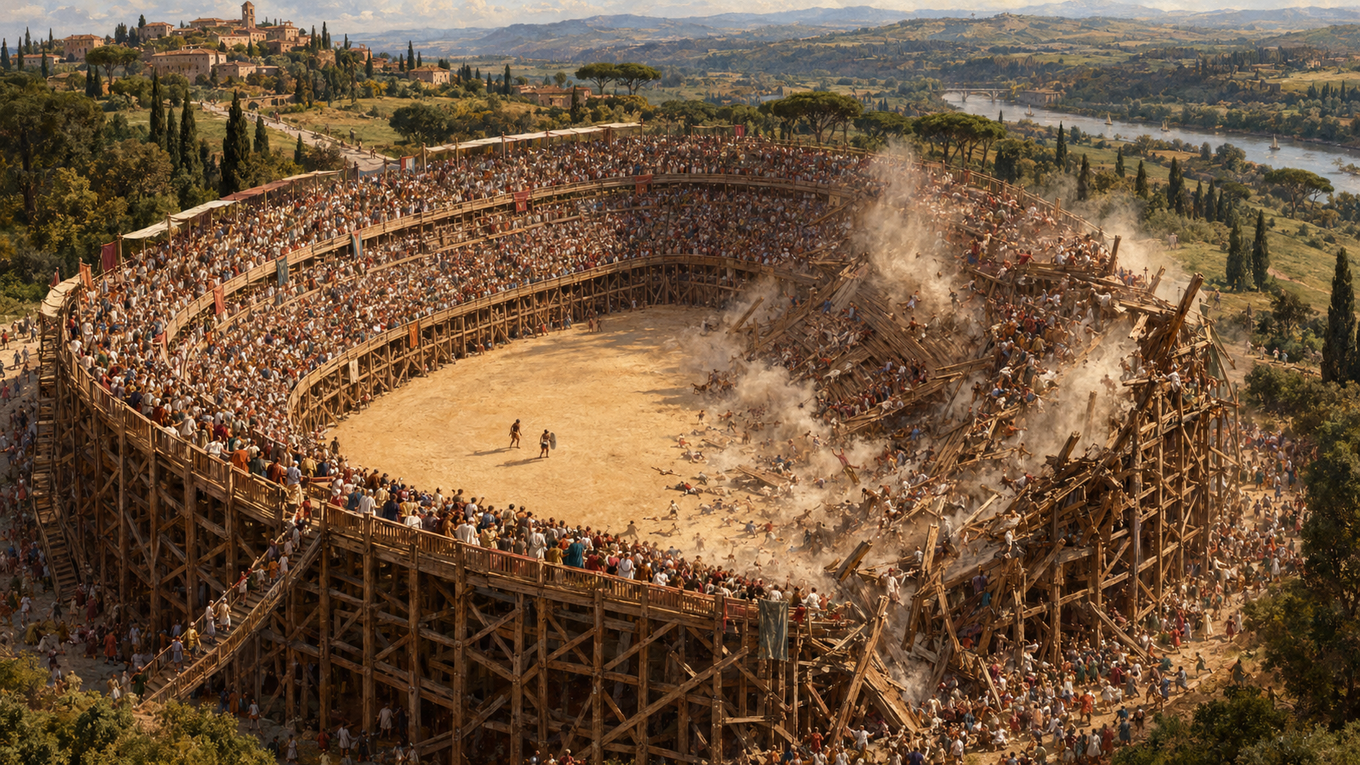
In AD 27, the people of Rome flocked out along the Via Salaria to the little town of Fidenae, eight kilometres north of the city, to see something they had been starved of for years: gladiators. A new wooden amphitheatre had gone up there, and it was soon packed with men, women and children, while more people milled around outside. Then the whole structure gave way. It either fell inwards or burst outwards, the historian Tacitus says, and it took the crowd down with it, “precipitating and burying an immense multitude which was intently gazing on the show or standing round.”
When the dust settled, tens of thousands of people were dead or maimed. It was the deadliest stadium disaster in history.
A city starved of games
Gladiator fights were hugely popular in Rome, but the emperor Tiberius did not care for them. According to his biographer Suetonius, he “gave no public shows at all,” rarely attended other people’s, and cut the cost of games by limiting the number of pairs of gladiators who could fight. Tacitus says that under Tiberius the people had been “wholly debarred from such amusements.”
By AD 27, Tiberius was not even in Rome. He had left the city the year before and would soon settle on the island of Capri. Whoever could offer the public a gladiator show stood to make a great deal of money.
The man who built on the cheap
That man was Atilius. Tacitus calls him “of the freedman class,” meaning a former slave, and he is scathing about his motives. Atilius was neither rich nor looking to win the public’s goodwill, as the wealthy men who usually sponsored games did. He “had simply sought the work for sordid gain.”
He built his amphitheatre at Fidenae, close enough to Rome to draw a huge crowd. Like many amphitheatres of the time, it was made of wood rather than stone. And Atilius cut corners. According to Tacitus, he “failed to lay a solid foundation” and failed to fix the wooden frame together “with beams of sufficient strength.”
In 2015 Rebecca Napolitano, then an engineering and classics student at Connecticut College, tried to reconstruct the amphitheatre using Tacitus’s account, the measurements of surviving Roman arenas and images of Roman timber structures on Trajan’s Column. Her best estimate was a building holding about 37,400 spectators, roughly the size of the great stone arena that still stands at Verona. Her analysis suggested that the timber posts had not been driven down to solid ground, which lay about 120 centimetres below the surface at Fidenae. Under the weight of the crowd, the shallow foundations shifted, putting far more strain on the joints of the frame than they had been built to take.
The collapse
The amphitheatre was packed. People had come from Rome “of every age,” Tacitus says, “men and women,” and still more crowded around the outside of the building. Then came “a violent shock.”
Tacitus’s description of what followed is one of the most harrowing passages in Roman history:
Those who were crushed to death in the first moment of the accident had at least under such dreadful circumstances the advantage of escaping torture. More to be pitied were they who with limbs torn from them still retained life, while they recognised their wives and children by seeing them during the day and by hearing in the night their screams and groans.
Trapped under the timbers, survivors lay among the dead into the night, listening to their families dying around them. As news spread, crowds rushed out from Rome to search for brothers, parents and children. Even people whose relatives had gone somewhere else entirely were frantic, because “it was not yet known who had been destroyed by the crash.”
When the rescuers began to clear the wreckage, there was “a rush to see the lifeless forms and much embracing and kissing.” Many of the bodies were so crushed that their families could not be sure who they were. Tacitus says that arguments broke out over corpses whose faces were too disfigured to identify but whose build and age seemed to match.
How many died?
The two ancient accounts give different figures. Tacitus says “fifty thousand persons were maimed or destroyed.” Suetonius says “more than twenty thousand spectators had perished.” The numbers do not necessarily contradict each other, since Tacitus is counting the injured as well as the dead. Ancient historians were fond of large, round numbers, and both men were writing long after the event, so the true figures may well have been lower. Napolitano’s reconstruction found that a building of around 37,000 seats, with a crowd outside as well, could plausibly have produced casualties on the scale of tens of thousands.
Even if the real toll was a fraction of these figures, Fidenae would certainly dwarf every modern stadium disaster. The deadliest of them, at the Estadio Nacional in Lima in 1964, killed 328 people.
Aftermath
The disaster brought Tiberius back from his retreat. Suetonius says he “was at once recalled by the constant entreaties of the people,” crossed over to the mainland and, unusually for him, “made himself accessible to all.” Meanwhile Rome’s nobles threw open their houses to the injured and paid for medicines and doctors. Tacitus, who rarely had a good word to say about his own times, thought it was like the old days, when Romans tended their wounded after a great battle.
The Senate passed two new rules. From then on, nobody worth less than 400,000 sesterces could put on a gladiator show, and no amphitheatre could be built “except on a foundation, the solidity of which had been examined.” Atilius was sent into exile.
The disaster also fed the gloomy mood of the year. When a great fire burned down much of the Caelian Hill in Rome soon afterwards, Tacitus says, people muttered that it was “an ill-starred year” and that the emperor’s departure from Rome had been made “under evil omens.”
Questions and answers
Was this the world’s first building-safety law?
No, though it may be one of the earliest recorded responses to a specific disaster. Builders had been held responsible for unsafe buildings for nearly two thousand years before Fidenae. The Babylonian Code of Hammurabi, written around 1750 BC, ruled that if a badly built house collapsed and killed its owner, the builder should be put to death, and if it killed the owner’s son, the builder’s son should die. What was different about the Senate’s decree was that it demanded the ground be inspected before an amphitheatre went up.
Why 400,000 sesterces?
It was not a random figure. Four hundred thousand sesterces was the property qualification for membership of the equestrian order, the knights, Rome’s second-highest social class, a rule set by the emperor Augustus. In practice, the Senate was limiting gladiator shows to the rich, who had the money to build properly and a reputation to lose. It was roughly the annual pay of about 450 legionaries. Freedmen like Atilius, out to make a quick profit, were now barred.
Did Tiberius ban gladiator games?
Not exactly. Some modern accounts say he banned them, but the ancient sources say something more modest. Suetonius says he cut the cost of games, limited the number of gladiators who could fight and “gave no public shows at all” himself. That left the people of Rome hungry for spectacle, and private promoters like Atilius stepped in to fill the void.
Have there been worse stadium disasters since?
Not even close, if the ancient figures are anywhere near correct. The deadliest modern stadium disaster, a crush at the Estadio Nacional in Lima in 1964, killed 328 people. Even if Tacitus and Suetonius exaggerated the Fidenae death toll tenfold, it would still be several times worse than any modern stadium disaster.
Key dates
- AD 14
- Tiberius becomes emperor; he gives no public shows and limits the number of gladiators at games
- AD 26
- Tiberius leaves Rome for Campania, and later the island of Capri
- AD 27
- Atilius's wooden amphitheatre at Fidenae collapses during a gladiator show; Tiberius returns to the mainland
- AD 27
- The Senate bans anyone worth less than 400,000 sesterces from staging gladiator shows and requires amphitheatres to stand on tested ground; Atilius is exiled
Further reading
Savagery in Sandals: The Gladiators of Ancient Rome
Various · A collection of classical writings on gladiatorial combat, the arenas built for it and the men who fought in them.
View on Bookshop.org: Savagery in Sandals: The Gladiators of Ancient Rome
Those Who Are About To Die: Gladiators and the Roman Mind
Harry Sidebottom · A history of gladiatorial combat and what it reveals about how Romans thought about death, violence and spectacle.
View on Bookshop.org: Those Who Are About To Die: Gladiators and the Roman MindThis article contains affiliate links. If you buy through them, Yorewire may earn a small commission at no extra cost to you. Affiliate disclosure.
Sources
- 1Tacitus, Annals, book 4, chapters 62–63, trans. Alfred John Church and William Jackson Brodribb (1876) (The fullest ancient account of the disaster, written about ninety years later by Rome's greatest historian.)
- 2Suetonius, Life of Tiberius, chapters 34, 40 and 47, trans. J. C. Rolfe (Loeb Classical Library, 1913) (The only other ancient account of the collapse, and the source for Tiberius's attitude to public shows.)
- 3Rebecca Napolitano, 'Failure at Fidenae: Visualization and Analysis of the Largest Structural Disaster in the Roman World' (BA thesis, Connecticut College, 2015) (An undergraduate thesis combining classics and engineering to reconstruct the amphitheatre and estimate how and why it failed.)
- 4'Fidenae', 'Equites', 'Code of Hammurabi' and 'Estadio Nacional disaster', Wikipedia (Used for the location of Fidenae, the equestrian property qualification, Hammurabi's building laws and modern stadium disasters. Wikipedia's claim that Tacitus's 50,000 was the size of the audience is a misreading.)